

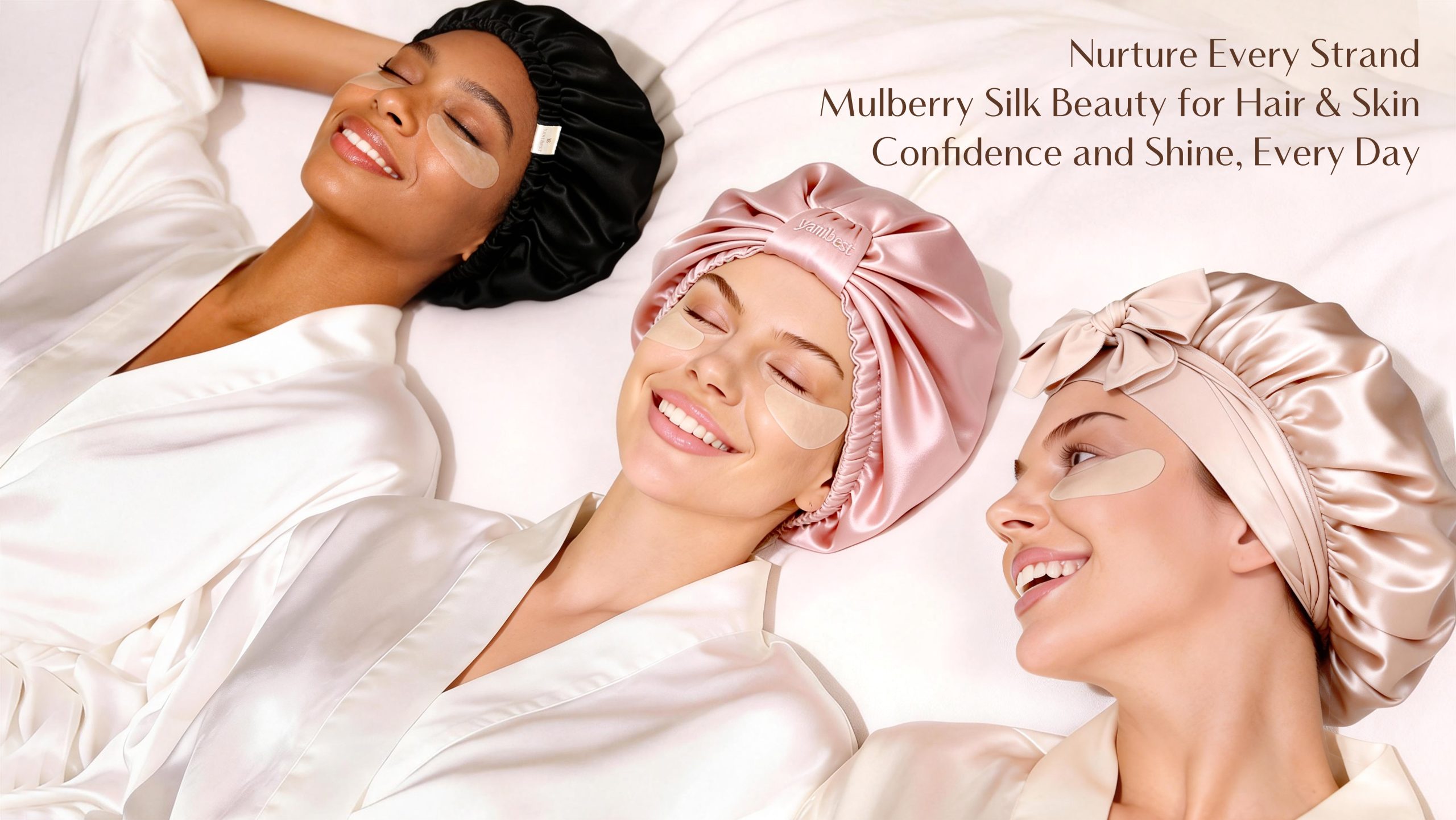
Comparative objective and immediate relevance
This report compares mulberry silk and commercially labeled “pure silk” for use in bonnet linings and related headwear, focusing on fiber morphology, surface friction, moisture transport, and implications for hair shaft integrity. For everyday users who prioritize reduced cuticle abrasion and night-time moisture retention, a well-constructed satin lined beanie often applies the same material principles discussed here.

Definitions and nomenclature clarity
Mulberry silk: cultivated Bombyx mori silk characterized by long, continuous filaments and relatively uniform diameter. “Pure silk”: a marketplace designation indicating 100% silk composition but not a species or filament-length specification; it can originate from different silkworm species or contain shorter-staple fibers. Distinguishing fiber origin and filament continuity is essential because those parameters determine mechanical behavior and surface topology.
Mechanical and biochemical properties relevant to hair health
Filament continuity: continuous mulberry filaments produce a smoother surface with fewer micro-irregularities. Protein composition: silk fibroin presents a keratin-compatible surface chemistry, reducing biochemical incompatibilities with hair cuticle proteins. Tensile behavior and elastic modulus: higher filament uniformity confers greater tensile resilience and less pilling; that lowers loose-fiber generation that can mechanically abrade hair. Moisture management: silk is hygroscopic but does not trap water against the cuticle the way cotton does; it allows controlled moisture exchange, reducing desiccation or over-humidification during sleep.
Comparative friction and abrasion outcomes
Surface microtopography dictates friction coefficient. A mulberry-sourced, degummed (sericin-removed) filament typically yields the lowest friction against the hair shaft compared with shorter-staple or unrefined silk labelled as “pure.” Lower friction translates to fewer frictional forces during scalp movement and turning, decreasing cuticular lift, split-end propagation, and detangling stress. Quantitative friction measures vary by testing method; clinically, the observed outcome is reduced visible frizz and fewer mechanical breakage events when filament continuity and smoothness are optimized.
Clinical relevance and a real-world anchor
Dermatology and trichology discussions at recognized forums such as the American Academy of Dermatology emphasize mechanical protection strategies for textured hair types. That guidance has led clinicians to recommend protective headwear; for example, practitioners often cite evidence when advising clients to use satin lined hats for curly hair to limit nocturnal friction-induced damage. This reflects practical consensus rather than a single randomized trial, and it aligns with observational reports from hair-care specialists.
Practical selection criteria and common pitfalls
Select based on verified filament source and weave type rather than marketing terms. Verify: 1) species origin (Bombyx mori preferred for consistent filament length), 2) degumming status (sericin removed to reduce stickiness), 3) momme or weight specification for durability, and 4) construction quality—seam placement and elastic width affect pressure points and slippage. Pitfalls: assuming satin equals silk—the satin weave can be created from polyester, which increases static and can exacerbate frizz. Overwashing with alkaline detergents or high-temperature drying degrades fibroin and increases roughness; use gentle, pH-neutral cleaning and low-temperature care.
Alternatives evaluated briefly
Polyester satin: lower cost, higher static, less hygroscopic—useful when budget dictates but suboptimal for minimizing cuticular friction. Silk blends: may improve durability but can reintroduce surface irregularities if short fibers are present. Pure silk items without species disclosure: acceptable if provenance and momme meet quality benchmarks, but they require closer scrutiny against mulberry-sourced specimens.
Summary synthesis and product-aligned solution
Choose linings that minimize surface roughness and maintain controlled moisture interaction; prioritize mulberry filament integrity where possible. When balancing clinical benefit and consumer constraints, a carefully built satin-lined solution that follows these material specifications offers measurable reduction in friction-related hair damage, a conclusion consistent with clinician recommendations and product development choices available through yanibest.