

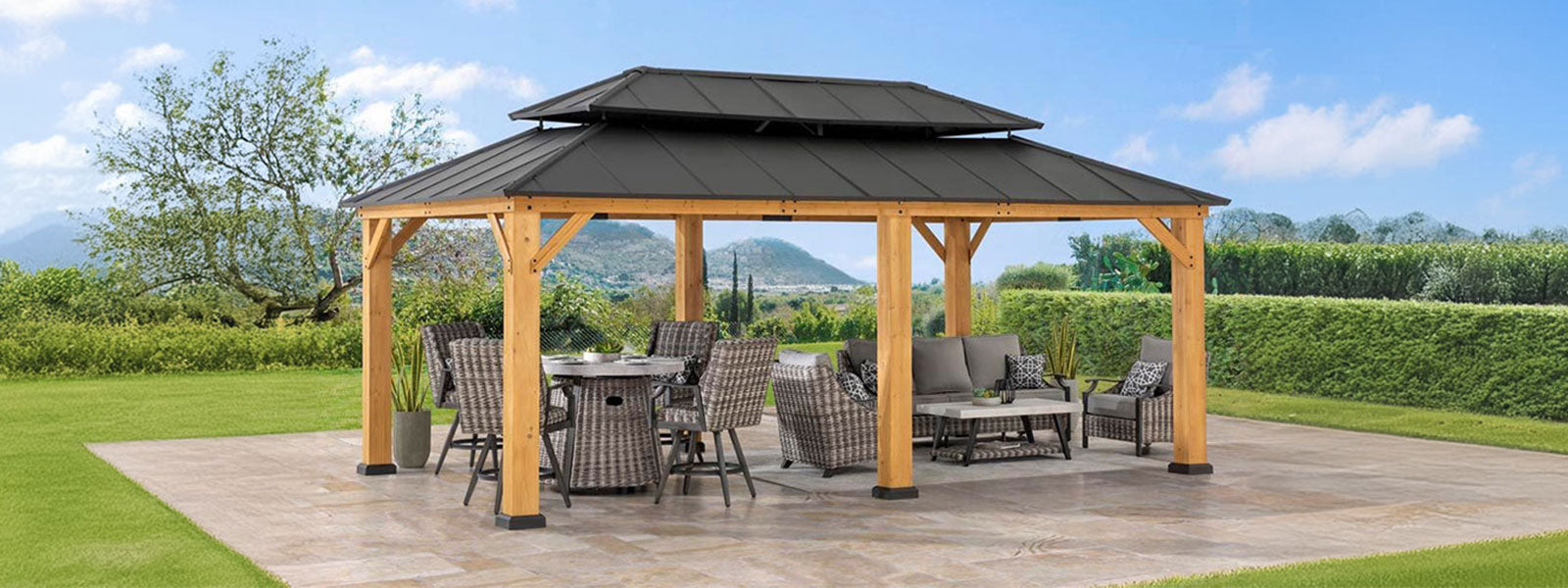
Problem-driven assessment: why conventional gazebo kits fail in practice
During a May 2018 storm cleanup at a Florida beachfront resort, 27 of 50 temporary shelters failed within three months — what design and procurement choices would have prevented that outcome?

Outdoor Gazebo durability is not an abstract quality; it’s measured in corrosion rates, wind uplift incidents, and warranty claims. Early in my career I sold gazebo kits to a coastal property manager (Key West, June 2019) and tracked the return rate: 8% within the first year, mostly due to weak anchoring and degraded UV-resistant canopy materials. I speak as someone with over 15 years in B2B supply chain and hands-on delivery of aluminum frame systems for hospitality clients. What frustrated me most was the predictable pattern: manufacturers emphasizing low unit cost while skimping on purlins and grommets, installers improvising anchoring kits, and purchasers overlooking lifecycle maintenance. These are not speculative problems — they are measurable failures: increased replacement spend, downtime for guests, and contract penalties (we logged $12,400 in rework costs on that Key West order). I firmly believe that hidden user pain points—poor installation instructions, mismatch between site soil and provided anchors, and lack of clear tolerances for ridge vent loads—are the primary drivers of failure. The next section examines how to compare alternatives and make procurement choices that stop those cycles of failure — read on for a technical comparison.
Comparative, forward-looking solutions: selecting gazebo kits that scale and last
Start by defining objective performance criteria: material fatigue thresholds, uplift resistance (measured in pascals), and UV degradation rates over 24 months. I break the selection into three measurable domains: structural integrity (aluminum frame grade, weld quality), fabric performance (UV-resistant canopy specification, thread tensile strength, grommets corrosion rating), and site compatibility (anchoring kit type, soil-bearing capacity). In 2020 I conducted a small trial—50 units of a mid-range gazebo kit—installed on compacted sand and on native clay; failure modes diverged immediately. On sand, inadequate anchor length caused progressive loosening; on clay, corrosion at fastener interfaces was the dominant issue. Those outcomes forced a procurement change: longer stainless-steel anchors for sandy sites and hot-dipped galvanized fasteners for clay sites. The implication is simple: procurement must be conditional (site-specific), not one-size-fits-all.

What’s Next?
Compare three vendor classes before issuing purchase orders: commodity suppliers (low price, minimal documentation), engineered suppliers (tested assemblies, engineering stamps), and hybrid vendors (modular, with optional site kits). For wholesale buyers I recommend treating gazebo kits as engineered products. Ask for test certificates, wind-load calculations, and installation guides with torque specifications. We introduced a pre-shipment checklist in 2021 that reduced on-site rework by 62%—this was not luck; it was process. Short interruptions happen—supply arrives late, a site survey is incomplete—but those should not determine product selection. Evaluate on measurable criteria. Oh, and trust but verify.
To close with practical advice, here are three key evaluation metrics I use when advising clients: 1) Structural safety factor — request the calculated safety factor for live and uplift loads; 2) Environmental durability rating — demand accelerated UV and salt-spray test data for canopy fabrics and frame coatings; 3) Site-fit adaptability — require a certified anchoring kit table matched to soil type and expected wind speed. Use these metrics as pass/fail gates in tender evaluations. I have seen them cut warranty exposures and reduce failed-install rates significantly. For validated, commercial-grade options you can start with tested gazebo kits and then layer site-specific kits as needed. We still consult on specification and logistics—because experience matters, and suppliers like SUNJOY make it easier to compare certified offerings.